

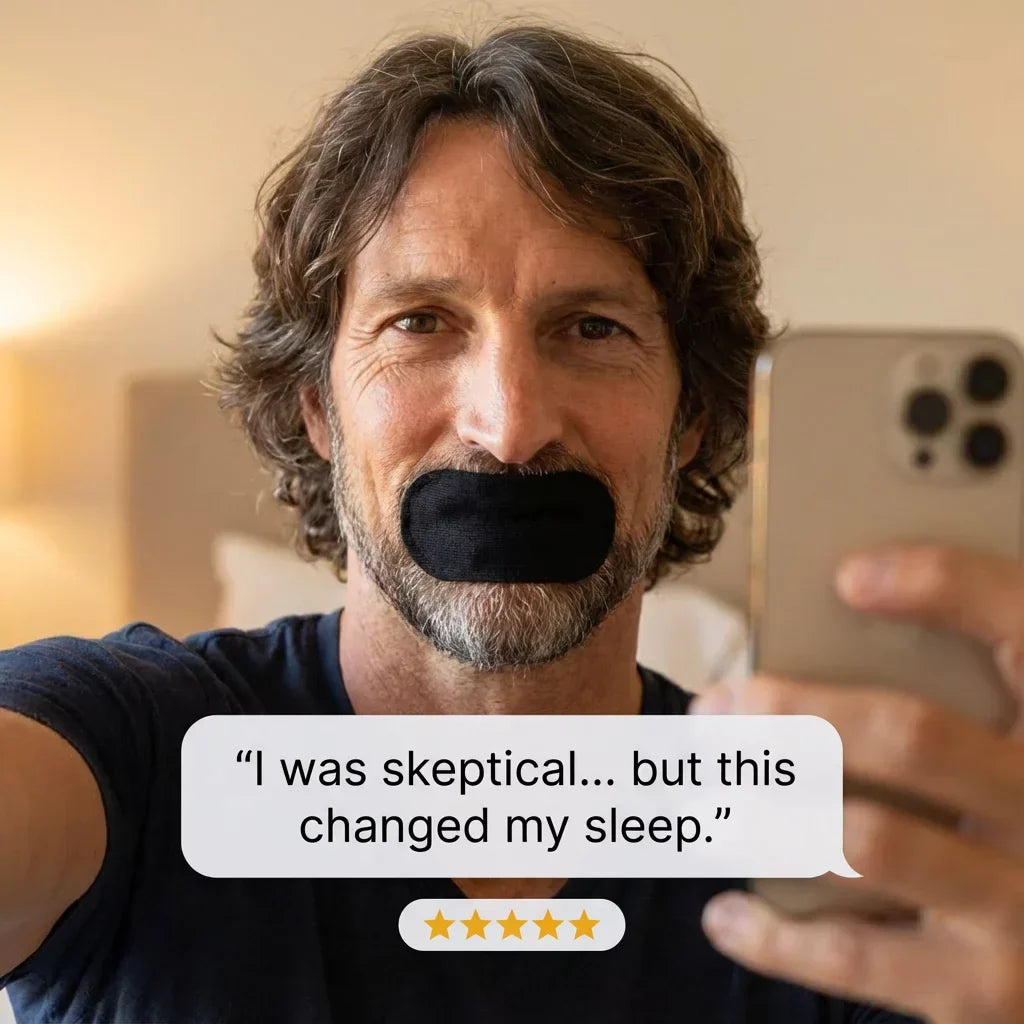
Does Mouth Taping Work? What the Research Shows
Meta Description: Does mouth taping actually work? This guide examines the scientific research and evidence behind mouth taping for snoring, sleep apnea, and overall sleep quality, with citations from clinical studies.
Author: Alex Neist
Table of Contents
- The Bottom Line: Does Mouth Taping Work?
- What the Scientific Research Says
- Limitations of the Current Research
- What Users Report
- Conclusion: What the Findings Mean
The Bottom Line: Does Mouth Taping Work?
Small studies report reduced snoring and lower sleep-apnea severity measures in selected adults with mild OSA. Hostage Tape’s clinical-study summary also reports better participant-rated sleep quality. These are different outcomes: a change in snoring, an AHI measurement, and a sleep-quality rating should not be treated as interchangeable [1–3].
This article compares two peer-reviewed studies with Hostage Tape’s published clinical-study summary, focusing on who was studied, what was measured, and what the findings mean.
What the Scientific Research Says
The studies below used different products and measured different outcomes. The independent papers are not endorsements of Hostage Tape.
Mouth Taping and Snoring
A 2015 pilot study in Otolaryngology–Head and Neck Surgery followed 30 patients with mild obstructive sleep apnea (OSA) and habitual open-mouth breathing during sleep. With a porous oral patch, measured snoring intensity and snoring frequency decreased. The study also reported a lower group median apnea-hypopnea index (AHI), a measure of sleep apnea severity. These findings concern the studied patch and population [1].
Mouth Taping and Sleep Apnea
A 2022 retrospective study in Healthcare examined 20 adults with mild OSA who breathed through their mouths and tolerated mouth sealing. Home sleep tests before and one week later with 3M silicone tape showed median AHI declining from 8.3 to 4.7 events per hour. This is a group median, not proof that every participant reached a normal range or that mouth tape cures sleep apnea [2].
The study compared participants with their own baseline and had no separate control group. Its findings do not establish mouth taping as a replacement for prescribed sleep-apnea treatment [2].
Mouth Taping and General Sleep Quality
Hostage Tape’s published clinical-study summary reports that 84.6% of final study participants reported better sleep. The three-week, single-blind study used an active comparator and validated scales. This percentage counts participants who improved; it does not mean sleep quality improved by 84.6%. The finding describes participant-reported sleep quality, not measured deep-sleep minutes or an OSA treatment result [3].
Limitations of the Current Research
Read each result in the context of its study:
- Study size and population: The two independent studies discussed here included 30 and 20 participants with mild OSA. They do not represent every person who snores [1,2].
- Study design: Comparing participants before and during an intervention differs from comparing randomly assigned groups. The 2022 study was retrospective and had no separate control group [2].
- Different endpoints: AHI, measured snoring, and participant-rated sleep quality answer different questions. Keep the measurement and study population attached to the result [1–3].
- Source scope: The Hostage Tape figures here come from the brand’s published clinical-study summary. They should not be represented as an independent audit of the underlying study [3].
What Users Report
While the scientific evidence is still developing, many users report positive experiences with mouth taping. Common anecdotal reports include:
- Reduced snoring
- Waking up with less dry mouth
- Feeling more rested and refreshed
These user experiences are valuable, but they are not a substitute for scientific evidence. For a more detailed look at what users report, see our article: The Complete Guide to Mouth Taping.
Conclusion: What the Findings Mean
The studies reviewed here report benefits in specific outcomes and populations: reduced snoring, lower group AHI, and improved participant-rated sleep quality. Read those outcomes separately. They do not establish that mouth taping cures sleep apnea or that every user will have the same result [1–3].
If you are considering trying mouth taping, it's essential to consult with a healthcare professional to ensure it is safe for you. For more information on safety, read our article: Is Mouth Taping Safe? What Medical Experts Say.
References
[1] Huang, T. W., & Young, T. H. (2015). Novel porous oral patches for patients with mild obstructive sleep apnea and mouth breathing: a pilot study. Otolaryngology–Head and Neck Surgery, 152(2), 369-373. Read the 2015 pilot study
[2] Lee, Y.-C., Lu, C.-T., Cheng, W.-N., & Li, H.-Y. (2022). The Impact of Mouth-Taping in Mouth-Breathers with Mild Obstructive Sleep Apnea: A Preliminary Study. Healthcare, 10(9), 1755. DOI: 10.3390/healthcare10091755. Read the 2022 study
[3] Hostage Tape. The Science Behind Mouth Tape. Brand-published clinical-study summary, accessed September 29, 2026. Read the clinical-study summary
IMPORTANT DISCLAIMER: This article is for informational purposes only and does not constitute medical advice. Always consult with a qualified healthcare professional for any health concerns or before making any changes to your health routine.
Share:
Mouth Taping Side Effects: What to Expect & When to Stop
Mouth Taping for Snoring: Does It Help?